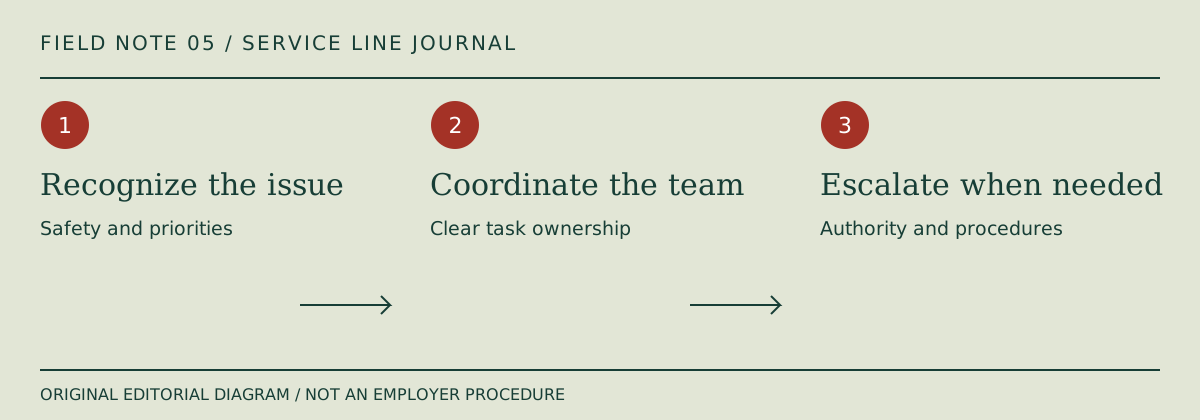
A move toward restaurant leadership usually involves more than becoming faster at your own station. It can mean coordinating handoffs, helping coworkers prioritize, spotting problems early and knowing when a decision belongs to someone more senior. The precise authority of a shift leader or manager depends on the vacancy and the employer's operating structure.
Sizzling Platter's careers page includes company-selected progression stories. One describes Faith Huntington moving through lead-manager and general-manager positions into a training-coordinator role. These examples show paths the company chooses to highlight. They do not establish a standard promotion timetable or guarantee that a similar opening will be available to another employee.
Understand the boundaries of the role
Before applying, read beyond the title. Ask whether the position includes opening or closing responsibilities, coaching, stock checks, guest recovery, cash handling or scheduling input. Do not assume that a leadership title gives authority to change prices, approve refunds, alter time records or make staffing decisions independently.
A good interview question is: 'Which decisions would I make during a shift, and which should I escalate?' The answer helps distinguish genuine supervisory responsibility from a title used differently at another restaurant. It also shows that you value consistent procedures rather than improvising around important controls.
Practice prioritizing a realistic situation
Imagine a rush in which an order is delayed, a coworker is unsure of a procedure and a guest wants an update. A useful response is to identify immediate safety concerns, communicate clearly and divide attention without abandoning a critical task. You might ask an authorized teammate to update the guest while you arrange trained help for the coworker.
This is a practice scenario, not a Sizzling Platter assessment question or an instruction to override restaurant procedures. The important skill is explaining your reasoning: keep people safe, preserve clear ownership of the tasks and involve the appropriate manager when you lack authority or information.
Build evidence for a development conversation
- Record examples of reliable attendance and consistent task completion.
- Describe a time you helped a teammate learn without guessing at a procedure.
- Note how you communicated a shortage, delay or mistake early.
- Ask which training milestones would prepare you for additional responsibility.
- Agree on what feedback would show improvement and when to revisit progress.
Clarify pay and expectations together
A new title can change responsibilities without answering every question about compensation. Ask about pay basis, expected hours, training arrangements and how extra hours are handled. The Department of Labor's restaurant toolkit includes guidance on manager classifications; a title alone does not determine whether a worker is exempt from overtime requirements.
If you are already employed, frame your interest as a specific learning goal rather than a demand for a promised promotion. If you are applying externally, compare the written role with your experience and ask about gaps. Clear scope, feedback and realistic next steps are more useful than assuming every restaurant offers the same leadership ladder.
Lead the handoff, not every task
One practical difference between strong individual performance and shift coordination is what happens when work crosses stations. Suppose order assembly repeatedly waits for one ingredient. A leader should first understand the cause: an unclear request, a preparation delay or a stock problem may need different responses. Simply urging everyone to work faster does not identify the obstacle. Ask the responsible teammate what is ready, communicate the constraint and coordinate an authorized adjustment.
In an interview, explain how you would check that the adjustment worked. You could describe confirming who owns the next step and checking back after the immediate pressure passes. Avoid promising a specific service time without knowing the kitchen situation. Clear, accurate updates are more useful than a confident promise the team cannot keep.
Coach without guessing
Coaching is not just correcting a mistake in front of other people. Imagine a new coworker repeatedly handing off orders without a required check. A useful approach is to confirm the correct process with the designated trainer, explain the missed step clearly and observe the teammate trying it again. If you are not trained to teach the task, arrange qualified support rather than improvising instructions.
The follow-up matters. Ask what made the step difficult: the instructions may have been unclear, supplies may be out of reach or competing requests may be interrupting the sequence. That question does not excuse skipping a required procedure. It helps distinguish a training need from an organizational problem and creates a more useful conversation than describing someone as careless.
Ask about a real development plan
- Which tasks must I demonstrate before coordinating a shift?
- Who observes those tasks and gives feedback?
- Is there supervised practice before I take responsibility alone?
- What support is available if a problem arises during opening or closing?
- Does completing training qualify me for consideration, or is an open position also required?
- When would responsibilities, title and compensation changes be confirmed in writing?
Bring one or two concrete examples to the discussion rather than a long list of qualities. For instance, explain how you noticed a supply shortage early, informed the right person and helped the team avoid confusion. Do not invent a sales increase or attach a number to an outcome you did not measure. Keep any learning record free of private customer information and confidential employee details.
Evaluate the offer as a whole
If a leadership opportunity includes responsibility across locations, ask which locations, how travel works and who provides direction at each site. If it focuses on closing, clarify the required checks and whom to contact when something cannot be completed safely. These questions help reveal the practical workload behind a title without assuming any particular company arrangement.
Finally, separate readiness from opportunity. You can make progress in communication, training and consistent execution even when no promotion is immediately available. A useful next step might be a supervised responsibility and a scheduled feedback conversation. It should be specific enough that you and your manager can later discuss what improved, what still needs practice and whether an appropriate vacancy exists.
Continue reading
Restaurant Pay Records: What to Save and Where to Get Help
Preparing for a Restaurant Interview Without Memorizing a Script