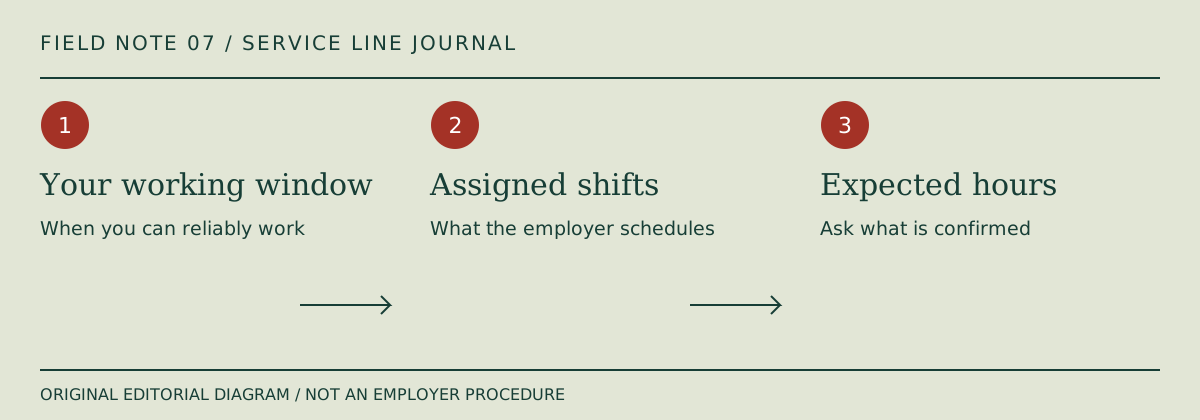
Availability is the time you can reliably work. A schedule is the set of shifts an employer assigns. Expected weekly hours are another detail again. Keeping these ideas separate can prevent a job conversation from sounding settled when important practical questions are still unanswered.
This article offers general planning advice for restaurant applicants and employees. It does not establish a Sizzling Platter scheduling policy, a guaranteed number of hours, a shift-swap process or a notice period. Check the specific vacancy and ask the hiring manager how the location handles these matters.
Build your realistic working window
Start with fixed commitments, then add travel and recovery time. If a class finishes at four and the journey takes forty minutes, a four-thirty arrival is not dependable. If the final bus leaves before a possible closing shift ends, identify another reliable option before offering that availability.
Write the result in plain language: 'On weekdays I can arrive after five-thirty and need to leave by ten.' If weekends differ, list them separately. You do not need to disclose every personal reason for a limit, but you do need to communicate the limit accurately enough for the employer to assess coverage.
Ask about the schedule you would actually receive
- What days and time periods does this vacancy need to cover?
- What weekly hours are expected, and is any minimum guaranteed in writing?
- How are schedules shared, and when are they normally available?
- What is the process for requesting time off or changing availability?
- Who approves shift swaps or additional hours?
- What should an employee do if transport or illness affects a shift?
These questions seek information; they do not imply that any particular answer is standard across the company. If the conversation includes an important assurance, ask where it appears in the job or offer materials. Distinguish a typical pattern from a contractual commitment.
Compare two opportunities fairly
Imagine one role advertises a higher hourly rate but requires a longer journey and uncertain hours. Another offers a lower rate close to home. Without knowing the likely schedule, neither headline rate tells you what the arrangement would feel like or what income to expect.
Make a simple comparison using confirmed information: travel cost, earliest arrival, latest departure, stated hours and training expectations. Mark unknown details as unknown instead of filling them with optimistic assumptions. If a second job is involved, consider how conflicting changes would be handled before promising both employers unrestricted flexibility.
Young workers need an additional check
The Department of Labor explains that federal rules restrict certain restaurant tasks for workers under eighteen and working hours for fourteen- and fifteen-year-olds. State law may provide additional protections. Legal permission to do some work does not mean a particular employer must hire at that age.
Check the vacancy's age requirement and the rules applying where the restaurant is located. When circumstances change, communicate promptly through the approved workplace channel and keep a record of agreed updates. The goal is a schedule that the employer understands and you can actually sustain, rather than the broadest possible promise during an interview.
Turn travel into a boundary, not a guess
Consider a fictional applicant whose bus journey normally takes thirty-five minutes. The last bus home leaves at 10:20 p.m., but the advertised role mentions closing duties without an end time. Saying “available until ten” may still be unclear: does ten mean leaving the building, finishing a customer order or beginning the cleanup? Ask when the person can realistically leave and what happens when closing work runs late. Do not infer the answer from the restaurant's public closing time.
This example is about planning, not a claim about any location's shifts. A useful working window has both an arrival boundary and a departure boundary. If transport is uncertain, state what you can reliably commit to while you investigate alternatives. Avoid accepting a recurring arrangement on the assumption that a coworker will always provide a ride unless that arrangement has actually been agreed.
Keep a change request easy to act on
A scheduling request should distinguish a one-time exception from a permanent change. “I need Tuesday, December 8 off” describes something different from “Starting December 8, I cannot work Tuesdays.” Include the effective date, the affected time window and whether previously assigned shifts are involved. Then ask who approves the change and how confirmation will be recorded.
A message is a request until the authorized person confirms it. A colleague saying they might cover a shift is not necessarily approval. Follow the location's actual process, retain the response, and check the updated schedule. If the request cannot be accommodated, clarify what options exist rather than silently assuming the original shift has disappeared.
Read an hours estimate carefully
Suppose a conversation mentions “around twenty hours,” while written materials state that hours vary. The estimate can help with planning, but it is not enough to claim a guaranteed weekly amount. Ask whether the figure describes recent practice, the hiring team's current need or a firm commitment. Request clarification about training weeks and whether shifts may be at more than one location.
For a personal comparison, write three columns: confirmed, typical but not guaranteed, and still unknown. Put the pay rate from the written offer in the first column only when it is actually confirmed. Put an informal hours estimate in the second. Leave travel between locations in the third until the arrangement is explained. This keeps uncertainty visible without turning a normal scheduling conversation into an accusation.
Review the arrangement after it starts
After several shifts, compare the actual pattern with the understanding you recorded. If the mismatch matters, bring specific examples and ask whether it is temporary or an ongoing need. The aim is to resolve a practical problem while it is still manageable, not to wait until conflicting commitments make attendance impossible.
Continue reading
Restaurant Pay Records: What to Save and Where to Get Help
Choosing a Restaurant Crew Role: What to Check Before Applying