Restaurant crew work is not one identical job across every concept. A posting may emphasize customer service, food preparation, order assembly, cleaning or a combination of tasks. Sizzling Platter's official jobs hub separates opportunities by brand, which is a useful starting point, but the actual vacancy should define the work you are considering.
The role descriptions below are general restaurant-career guidance. They are not a statement that every Sizzling Platter restaurant assigns the same duties, uses the same titles or follows one training schedule. Ask the hiring contact about the specific position and location.
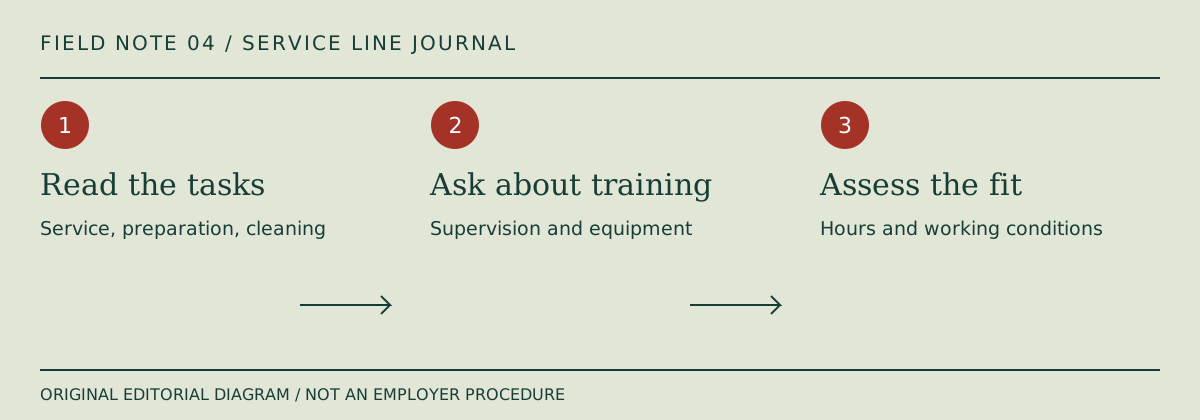
Think in tasks rather than titles
A customer-facing position may involve greeting guests, explaining options and coordinating orders. A preparation-focused position may require following recipes, maintaining a clean station and communicating when ingredients run low. Some positions rotate between tasks. Others require particular equipment training or have age-related restrictions.
Your strongest fit may depend on how you prefer to work. Someone who enjoys short conversations might like guest-facing duties. Someone who likes orderly, repeatable processes might enjoy preparation work. Neither is necessarily easy: both can involve time pressure, teamwork and attention to safety. A mixed role can offer variety, but clarify how responsibilities are shared during busy periods.
Questions that reveal the actual work
- Which tasks would I learn first, and who would supervise my training?
- Does this role rotate between service, preparation and cleaning?
- What equipment would I use, and what training happens before I use it?
- How are orders handed between stations during a rush?
- Are opening, closing or delivery-related duties part of this position?
- What should I do if a guest asks a question I cannot answer safely?
Show relevant experience honestly
You do not need to invent restaurant experience to explain useful skills. A school project can demonstrate reliability, a volunteer shift can show teamwork and a customer-facing activity can illustrate listening. Describe what you actually did and the result. Avoid claiming food-handling qualifications or equipment experience you do not have.
For example, you might explain how you kept a shared task organized when several people needed help at once. Then connect that experience to learning an order process and asking questions early. The point is to show a practical habit, not to suggest that a classroom activity is identical to commercial kitchen work.
Check age and working conditions
Federal and state rules can affect young workers' hours and permitted tasks. The Department of Labor's restaurant youth-employment guidance is a starting point, but an employer can also set requirements for a particular vacancy. There is no verified universal hiring age in this guide. Confirm the role's minimum age and duties directly.
Finally, consider the complete working arrangement: travel, availability, expected hours, training and the physical tasks described in the posting. If a requirement is unclear, ask how it is performed and whether an accommodation process is available. A well-understood role is easier to assess than an appealing title with important details missing.
Picture a complete shift
A useful way to compare two vacancies is to imagine the work before, during and after the busiest period. In a hypothetical counter-service restaurant, the first hour could involve stocking supplies and preparing a station. During the rush, the challenge may be keeping order details accurate while coordinating with another station. Later, cleaning and restocking still need attention even when the queue has disappeared. Ask which of these activities belongs to the advertised role.
Consider an applicant who enjoys greeting guests but has never operated food-preparation equipment. That person can explain their service strengths while asking how equipment training is provided. Another applicant may be comfortable following a preparation checklist but want practice speaking with guests. Neither needs to claim confidence in every task. What matters is understanding the starting responsibilities and the support available when learning something unfamiliar.
Compare the working day
Two jobs with the same title can fit your life differently. A nearby restaurant requiring early opening shifts may be harder to reach than a more distant restaurant on a reliable bus route. A closing shift may involve work after customer service ends. Ask about the expected finish time, rather than planning transport from the public closing time alone.
- Confirm the actual workplace address and whether shifts can involve other locations.
- Ask how much standing, carrying, reaching or repetitive work the role involves and how tasks are performed.
- Check any clothing or footwear requirements, associated costs and when you need the items.
- Ask how breaks, schedule changes and requests for help are handled at the location.
- Distinguish expected weekly hours from hours that the employer is actually committing to provide.
Use the answers to identify practical gaps before accepting. For example, if your last bus leaves shortly after the dining room closes, explain that limitation and ask whether the advertised shift can reliably finish in time. An optimistic assumption about transport is not a workable plan for repeated late shifts.
Turn your questions into a decision
After speaking with the hiring contact, divide your notes into three groups: confirmed duties, details still missing and conditions you cannot meet. A missing detail is a reason to ask a focused follow-up, not automatically a reason to reject the role. A regular shift outside your availability is a more concrete mismatch. Keep comparisons factual instead of ranking jobs only by a familiar restaurant name.
For a young applicant, compare the proposed tasks and schedule with the Department of Labor youth-employment guidance and the applicable state rules. Do not assume that being hired means every piece of equipment is permitted for your age. Ask who can clarify restrictions and provide training. Your final decision should combine interest in the work with a realistic schedule, clear duties and an understood way to raise questions.
Continue reading
Your First Restaurant Shift: What to Confirm and What to Ask
Restaurant Shift Leadership: Skills, Scope and Questions to Ask