Begin a Sizzling Platter job search at the official jobs hub, jobs.sizzlingplatter.com. The hub organizes opportunities by restaurant brand and includes a support-center route. Starting there gives you a clearer chain from the company to the application destination than an unsolicited message or an advertisement with a familiar logo.
Service Line Journal does not receive applications, collect resumes or hire for Sizzling Platter. Links to the company's resources are provided so you can review the live information yourself. Openings, application steps and providers can change after this guide is reviewed.
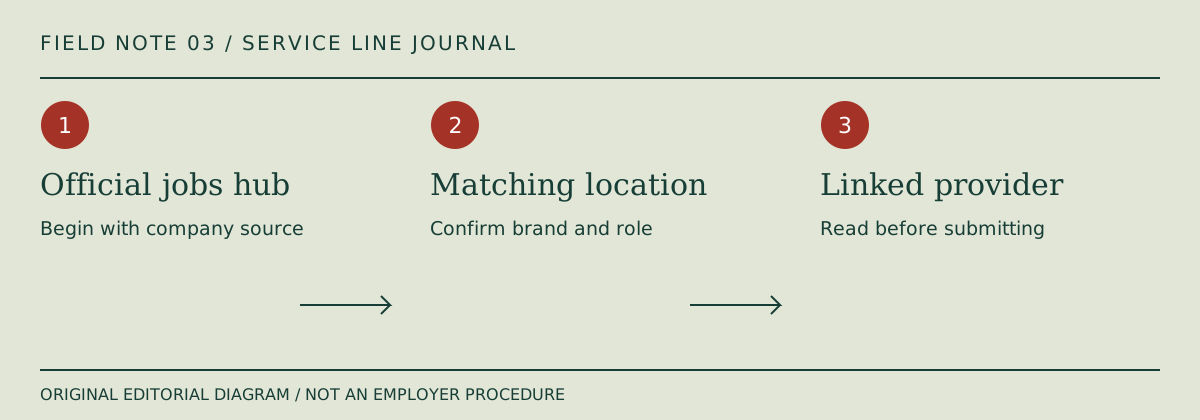
Follow the route, not just the logo
Choose the brand and region relevant to your search. The hub separates Little Caesars US and Mexico routes and provides different Jamba links for California and Washington. Check the eventual posting's address, employer, role and working arrangement before you begin entering information.
Some official links lead to external applicant-tracking services. The hub links to olivia.paradox.ai for several routes and to workstream.us for others. An external hostname is therefore not automatically suspicious. The useful check is whether you reached that exact destination from the official company hub, not whether a message merely says it uses a reputable service.
Keep a short application record
- Save the job title, restaurant address and employer name from the posting.
- Record the date you applied and the official route you used.
- Keep any confirmation or reference number without sharing it publicly.
- Note the stated contact method and any next step the application actually gives you.
- Review the privacy information before submitting personal details.
A record is especially helpful when applying to several restaurants with similar names. It lets you match an interview invitation to an application you recognize. It also makes a follow-up more precise: you can identify the role and address instead of asking a general corporate inbox to locate an unspecified application.
Treat unexpected requests carefully
The FTC warns that job scams can involve personal email accounts, unusually high pay, interviews conducted only through email or chat, and requests for sensitive information before the role is properly explained. It also advises that honest employers do not ask people to pay to get a job. These are general warnings, not allegations about Sizzling Platter.
If a message asks you to buy equipment, send money or provide banking details immediately, pause. Do not use contact details supplied only by the suspicious message to verify it. Return to the independently located official company website and use an appropriate published contact route to ask whether the approach is genuine.
Before following up
Read the confirmation first. It may already explain how updates are provided. If no timing is stated, a brief, polite inquiry can identify the job and ask whether further information is needed. Do not assume silence means acceptance, rejection or a guaranteed interview. Only the hiring team can confirm your application status or make an employment offer.
Verify the destination before entering information
A careful application journey has three parts: the official starting page, the link you choose and the destination that opens. Check each rather than relying only on a logo at the end. A web address that resembles a known provider is not the same as the exact address reached through the official hub. Be particularly cautious when an unsolicited message asks you to abandon the route you were already using.
This does not mean every application page must remain on the company's own domain. External recruiting services are part of the verified routing described above. It means the connection should be established through the official source. If you are unsure, close the unexpected link, navigate back to the official hub yourself and select the relevant brand and region again.
Choose the role before creating an application
Read the location as carefully as the title. A nearby city name may still involve a difficult commute, and a title can cover different duties at different restaurants. Check whether the vacancy describes one worksite, multiple locations or support-center work. Ask about an unclear reporting location before assuming that a familiar brand name makes the arrangement suitable.
Then compare the stated requirements with your actual experience and availability. Be truthful about qualifications, equipment experience and working hours. If a requirement is unclear, asking a focused question is more useful than claiming a qualification you do not have. Keep a list of unresolved details so they can be discussed with the hiring team rather than guessed from general career advice.
A hypothetical safe application sequence
Suppose Alex wants a restaurant role within a manageable journey from home. Alex starts at the official hub, chooses the appropriate brand and region, and opens a posting. Before applying, Alex records the title, employer, street address and the source link. Alex also notes that the page was reached through the official route, rather than through a text message.
After submitting, Alex keeps the confirmation and checks for instructions about next steps. Two days later, a message mentions a different city and asks for an immediate payment for training. Alex does not assume it relates to the saved application. Instead, Alex stops, compares the details and uses independently obtained official contact information to ask whether the approach is genuine. The example is hypothetical; the payment warning comes from general FTC guidance, not a reported incident involving this company.
Keep personal information tied to a clear purpose
An application may request information relevant to hiring, but you should understand who is receiving it and why. Review the provider's privacy information and distinguish an application from an unexpected request for sensitive onboarding details. Do not send account passwords or private documents to someone merely because they know you are job hunting.
If a later step requires information you did not expect, verify the step through your established contact or the official company route. Avoid posting application screenshots publicly when they include your address, identifiers or confirmation details. Service Line Journal does not need that information to explain the application process and does not provide an account that can check your status.
When a page does not work
A broken link, empty page or inaccessible application service is a technical obstacle, not a reason to switch to the first unofficial form in search results. Check whether you selected the correct country and state route. If the problem persists, use the company's published contact information to ask which application route serves the role you want. Do not invent a workaround that sends your information to an unverified recipient.
When asking for help, include the brand, location, role and a short description of the problem. You generally do not need to include sensitive documents to explain that a page will not load. Keep the request specific enough to route, and do not assume the general recruiting address can guarantee a response time or retrieve every application.
A final pre-submit check
- I can identify the official route that led to this page.
- The role, employer and work location match the opportunity I intended to pursue.
- My experience and availability are represented accurately.
- I understand what information I am submitting and to whom.
- I have not been asked to pay for the promise of a job.
- I know how to save the confirmation and any stated next step.
Continue reading
Preparing for a Restaurant Interview Without Memorizing a Script
Restaurant Schedules and Availability: Make the Details Concrete